Latent attention on masked patches for flow reconstruction (LAMP)
ICCS 2026 Workshops, Lecture Notes in Computer Science · pp. 181–188 · 2026
Abstract
Vision transformers have shown outstanding performance in image generation, yet their adoption in fluid dynamics remains limited. We introduce the Latent Attention on Masked Patches (LAMP) model, an interpretable regression-based modified vision transformer designed for masked flow reconstruction.
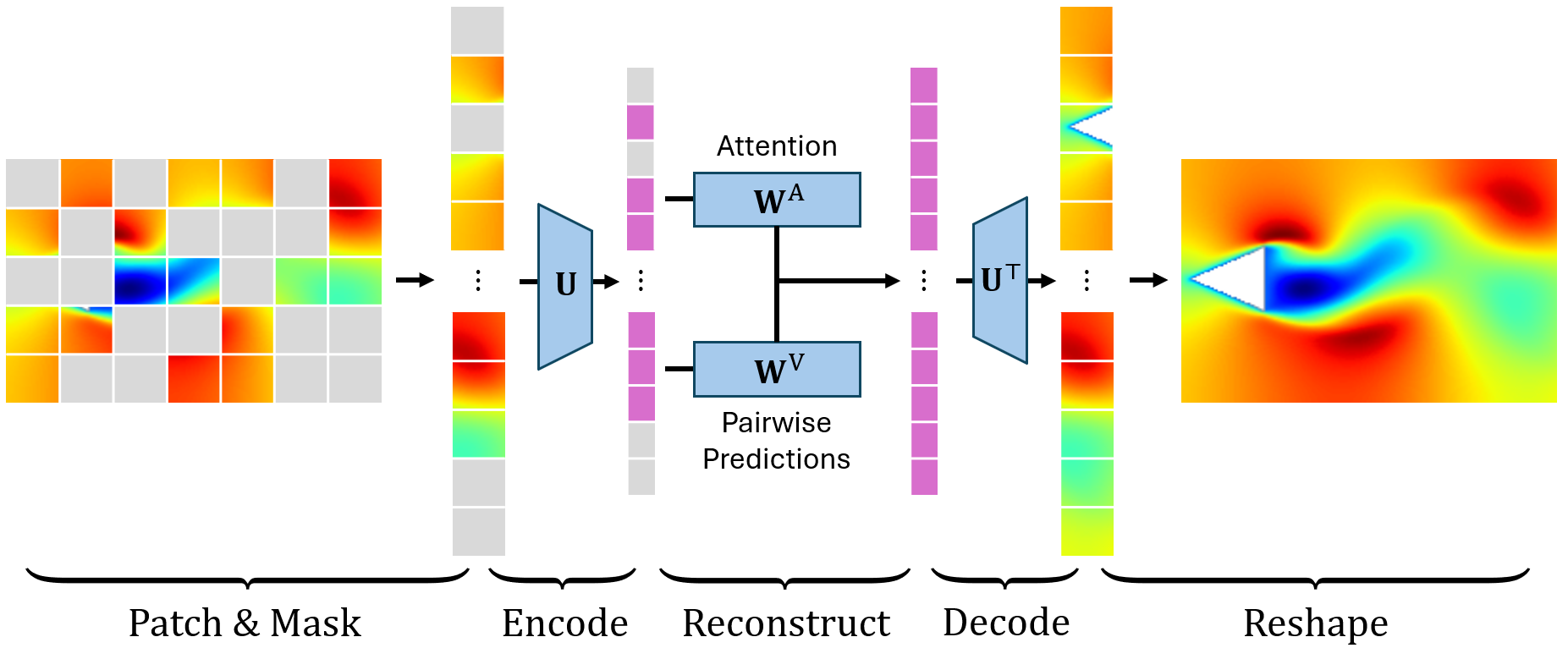
LAMP follows a three-fold strategy:
- Patching: each flow snapshot is partitioned into patches.
- Compression: patch-wise dimensionality reduction via proper orthogonal decomposition.
- Reconstruction: the full field is recovered from a masked input with a single-layer transformer, which is trained via closed-form linear regression.
We test the method on two canonical 2D unsteady wakes: a laminar wake past a bluff body, and a chaotic wake past two cylinders.
- On the laminar case, LAMP accurately reconstructs the full flow field from a 90%-masked and noisy input, across signal-to-noise ratios between 10 and 30 dB. Further, the learned attention matrix yields interpretable multi-fidelity optimal sensor-placement maps.
- On the chaotic wake, LAMP’s performance is limited, but it outperforms other regression methods such as gappy POD.
The modularity of the framework naturally accommodates nonlinear compression and deep attention blocks, thereby providing an efficient baseline for nonlinear, high-dimensional masked flow reconstruction.
Schematic of the LAMP model.
Cite this paper
- Eze, B., Magri, L., & Nóvoa, A. (2026). Latent attention on masked patches for flow reconstruction. In Computational science – ICCS 2026 workshops (Lecture Notes in Computer Science, pp. 181–188). Springer. doi10.1007/978-3-032-29915-4_15