A real-time digital twin of azimuthal thermoacoustic instabilities
Journal of Fluid Mechanics · 1001, A49 · 2024
Abstract
When they occur, azimuthal thermoacoustic oscillations can detrimentally affect the safe operation of gas turbines and aeroengines.
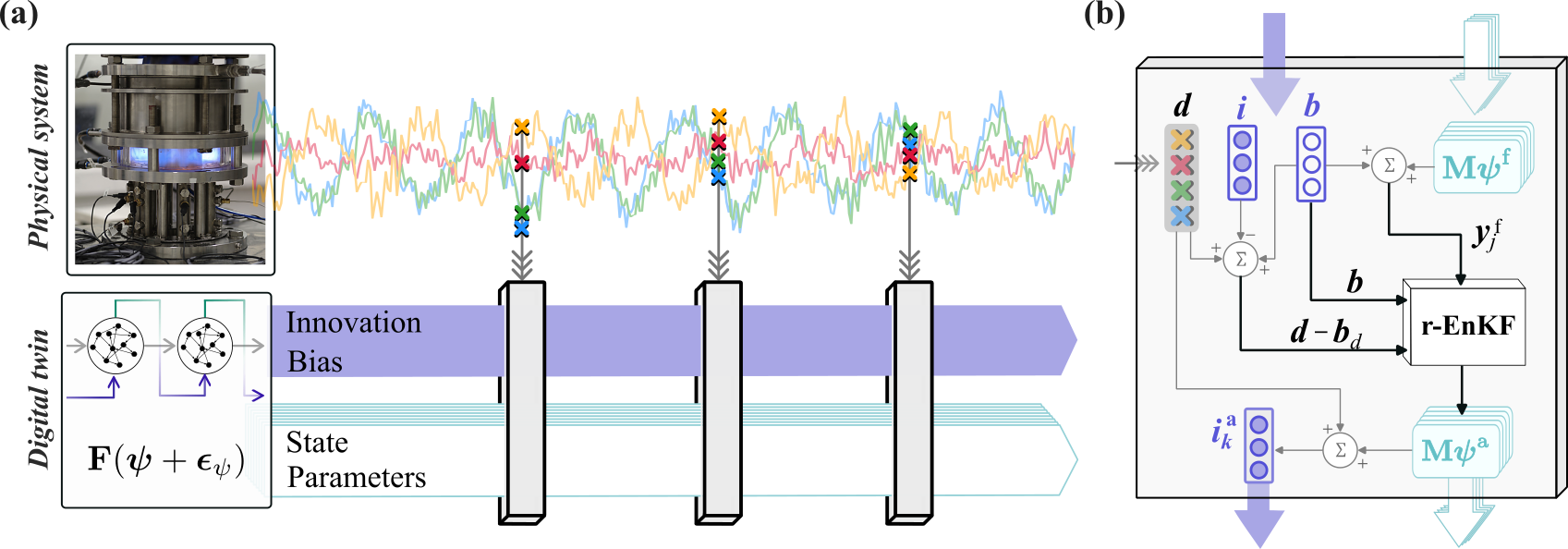
We develop a real-time digital twin of azimuthal thermoacoustics of a hydrogen-based annular combustor, which combines two sources of information:
- A physics-based low-order model – we derive a low-order thermoacoustic model for azimuthal instabilities, which is deterministic.
- Raw and sparse experimental data from microphones, which contain both aleatoric noise and turbulent fluctuations.
We derive an analytical solution of the bias-regularized ensemble Kalman filter (r-EnKF). The r-EnKF is a global solution of the data assimilation optimization problem which allows us to infer simultaneously and in real time:
- The acoustic pressure (i.e., the physical state)
- The model parameters
- Systematic errors in the model (the bias) and on the measurement data (shift) – we employ a reservoir computer to model the bias and the shift to close the assimilation equations.
We demonstrate the proposed methodology by delivering a real-time digital twin of the azimuthal thermoacoustic dynamics of a laboratory hydrogen-based annular combustor for a variety of equivalence ratios. We find that
- The real-time digital twin autonomously predicts azimuthal dynamics, in contrast to bias-unregularized methods.
- The r-EnKF acts as physics-based filter as it uncovers the physical acoustic pressure from the raw data.
- The thermoacoustic system is a time-varying parameter system – while existing models have constant parameters and capture only slow-varying variables.
- The digital twin generalizes to all equivalence ratios.
This work opens new opportunities for real-time digital twinning of multi-physics problems.
Schematic of the proposed digital twin framework.
Cite this paper
- Nóvoa, A., Noiray, N., Dawson, J. R., & Magri, L. (2024). A real-time digital twin of azimuthal thermoacoustic instabilities. Journal of Fluid Mechanics, 1001, A49. doi10.1017/jfm.2024.1052